
Industry News
Curation by industry experts
Hot Articles
Popular Tags
Wear Points That Shape Used Tyre Shredder Uptime and Maintenance Costs
Wear Points That Shape Used Tyre Shredder Uptime and Maintenance Costs
A tyre shredder rarely loses availability because one major component fails without warning. More often, downtime begins with gradual wear that changes how the machine pulls, cuts and discharges material. A cutter edge becomes rounded, a bearing seal starts admitting contamination, a screen opening bridges with wire, or a coupling develops increasing backlash. Each issue may appear manageable in isolation. Together, they can reduce throughput, increase power demand, overload downstream separation equipment and turn a planned service stop into an extended repair.
For after-sales maintenance personnel, the practical question is not simply whether a part is worn. It is whether the wear has reached the point where continuing to run will damage higher-value components, compromise product consistency, or create an unsafe intervention. This distinction matters especially when processing mixed end-of-life tyres, where tread thickness, steel content, moisture, embedded debris and feed preparation can vary significantly from one load to the next.
Maintenance cost is shaped by more than the price of replacement knives or bearings. It includes labour time, lifting access, lost production, spare-part lead times, post-repair alignment, disposal of worn metal parts and the risk that an unplanned stoppage interrupts material flow to granulators, magnetic separators or rubber-powder lines. A disciplined inspection routine helps maintenance teams decide when a lower-cost wear-part change is still possible and when the machine is approaching a more disruptive rebuild.
Why tyre feedstock accelerates wear in uneven ways
Tyres are not uniform cutting stock. Passenger-car tyres, truck tyres, agricultural tyres and off-road tyres can differ substantially in sidewall construction, bead-wire mass, tread thickness and reinforcement layout. A shredder may process a relatively predictable feed for several shifts and then encounter a batch containing thicker carcasses, muddy tyres, rim fragments or baled material that has trapped metal contamination.
The machine’s cutting chamber experiences a combination of abrasion, impact, compression and torsional loading. Rubber itself can be abrasive when loaded with road grit, while steel belts and bead wire impose repeated high-load contact on cutters, hooks, spacers and counter-knives. If the shredder is fed beyond the design conditions assumed by its configuration, wear may become concentrated on one section of the rotor or one pair of shafts rather than distributed evenly across the cutting set.
Uneven wear often creates a misleading operating pattern. The shredder may still start and turn normally, but material is pulled into the chamber less consistently. Operators may respond by increasing feed pressure or allowing a larger material pile at the infeed. That can raise torque peaks and increase the likelihood of shaft deflection, cutter collision, hydraulic overload trips or stalled material in the chamber. The underlying problem is then obscured by symptoms that look like a feed-control issue.
Maintenance teams should record the feed conditions present when wear is identified. Useful observations include tyre category, pre-cutting practice, visible rim contamination, moisture, storage conditions, loading method and whether material is delivered individually, by conveyor or in batches. These notes can reveal whether the root cause is a wear-part selection issue, an unsuitable operating setting or feedstock that requires better preparation upstream.
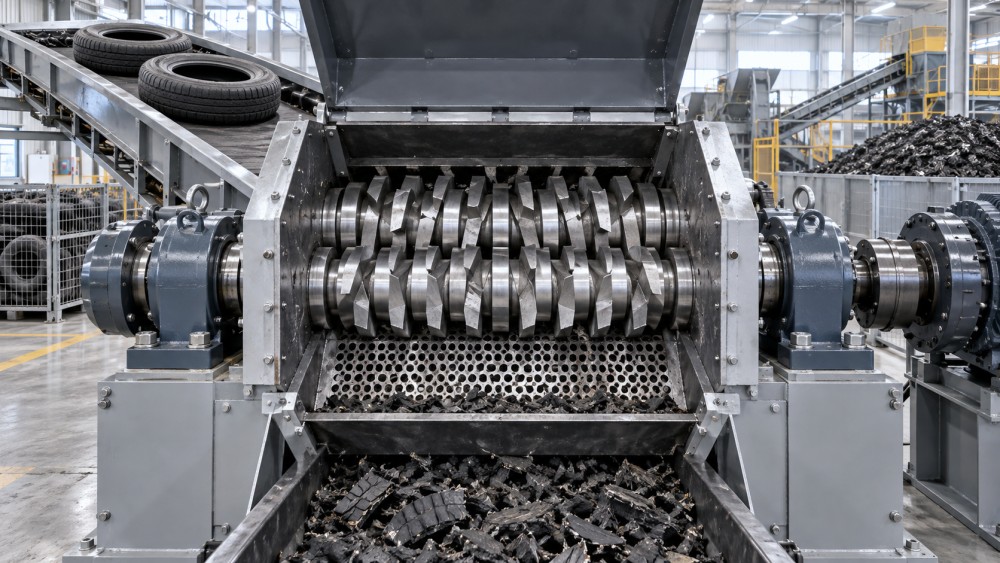
The cutting system is the first cost driver, but not the only one
Cutters, knives, hook profiles, spacers and counter-knives normally receive the most attention because their condition directly affects size reduction. Their wear pattern can also provide early evidence of problems elsewhere in the machine. A uniformly dull cutting edge suggests normal gradual wear. Local chipping, cracking, polished zones or damage concentrated on one side may point to hard contamination, incorrect cutter clearances, shaft runout, loose fasteners or an imbalance in material feed.
Cutting edges and hook geometry
As cutting edges lose definition, the machine tends to tear and compress rubber rather than shear it cleanly. The result can be longer strips, inconsistent chip size and more recirculation downstream. Increased residence time in the chamber also raises heat and load exposure. Where cutter design allows indexing or replacement of individual elements, maintenance staff should inspect mating faces and fastening surfaces as carefully as the visible cutting edge. A new cutter mounted against damaged spacers or contaminated shaft shoulders may not sit squarely, which can accelerate wear across the entire set.
Clearance is a working condition, not a one-time assembly measurement. Wear, thermal movement, shaft deflection and settling after service can alter the effective gap between rotating and stationary cutting elements. Excessive clearance reduces cutting action; insufficient clearance can create metal-to-metal contact and rapid heat generation. The correct setting must follow the equipment manufacturer’s documented limits for that cutter configuration. A generic clearance value is not a safe substitute because shaft diameter, cutting profile, material class and machine layout differ.
Screens, discharge grates and restriction points
Where a shredder uses screens or grates to control output size, these components can become a hidden throughput constraint. Worn openings may permit oversize material to pass, while blocked or distorted openings keep material in the cutting chamber too long. Steel wire strands are particularly prone to catching around restricted discharge areas. In some installations, an apparent loss of cutting performance is actually a discharge problem: material is adequately reduced but cannot leave the chamber at the expected rate.
Inspection should include screen thickness, broken welds, distorted frames, wire accumulation and the integrity of the fastening method. A screen that is difficult to remove during scheduled maintenance will be even more difficult to change after a jam, when hot material, residual load and limited access increase the intervention risk.
Shafts, bearings and seals
The shaft line carries the accumulated consequences of poor cutting conditions. Repeated overload events can increase bearing stress, while contamination entering through damaged seals can degrade lubrication and shorten bearing life. Symptoms may include increasing temperature, abnormal noise, metal particles in lubricant, recurring seal leakage or a need for repeated alignment correction.
Bearing replacement should not automatically be treated as an isolated repair. Before fitting a new bearing, inspect shaft journals, housing fits, seal tracks, retaining features and the alignment of the drive arrangement. A new bearing installed on a scored journal or in a distorted housing can fail prematurely even if the replacement part itself is correct. Where practical, trend vibration and temperature under comparable operating conditions rather than reacting only after a bearing becomes visibly noisy.
Drive components often determine the length of an outage
Cutters may be changed frequently, but damage to gearboxes, hydraulic motors, couplings or drive shafts usually causes longer downtime and higher repair cost. These components are designed around expected torque and shock loads. Repeated operation with dull cutters, overfeeding or hard contaminants can push the drive system into a cycle of torque spikes and reversals.
On mechanically driven systems, maintenance checks should include coupling wear, bolt security, guard condition, lubricant condition, oil leaks and unusual backlash. For hydraulic drives, inspect hose routing, fittings, filters, oil cleanliness, pressure stability and signs of overheating. A relief-valve event that occurs occasionally during difficult feed may be expected, depending on the machine design. Frequent relief operation, however, can indicate that the shredder is being asked to compensate for worn cutters, blocked discharge paths or unsuitable feed preparation.
Gearbox oil analysis can support condition-based maintenance, but results need context. A single sample may identify contamination or unusual metal content; a trend taken at consistent intervals is more useful for distinguishing a developing gear or bearing issue from a one-off event after repair. Sampling points, operating hours, oil top-ups and recent component work should be recorded with each result.
Separate normal wear from damage that requires immediate action
A practical maintenance plan should classify findings by operating consequence rather than by part name alone. This helps the team avoid both extremes: running a damaged machine until it fails, or replacing serviceable parts before their useful life has been reached.
Immediate-action findings generally include cracked rotating parts, loose cutting elements, damaged guards, exposed moving parts, fluid leaks that create fire or slip hazards, abnormal vibration, and any condition requiring a person to reach into the cutting chamber while stored energy remains. Production pressure should not redefine these risks as routine maintenance.
Safe access procedures protect both people and the machine
Shredder maintenance involves stored mechanical, hydraulic, electrical and gravitational energy. A chamber can retain material under compression, shafts may move during release of trapped force, and a hydraulic system may remain pressurised after the prime mover is stopped. The machine-specific isolation procedure should identify every energy source, the steps needed to dissipate or restrain that energy, and the verification method before work begins.
In the United States, OSHA’s lockout/tagout requirements are set out in 29 CFR 1910.147, which requires control of hazardous energy during servicing and maintenance. OSHA’s general machine-guarding requirements under 29 CFR 1910.212 also address protection from hazards created by points of operation, rotating parts and flying material. These requirements do not replace the equipment manufacturer’s procedures or local legal duties, but they provide a useful baseline for reviewing whether maintenance tasks are being planned with adequate isolation and guarding controls.
Before removing a jam or changing cutters, teams should confirm that the machine cannot restart from a local panel, remote control or automated upstream signal. They should also assess whether suspended covers, conveyors or hopper components need mechanical support. Returning the machine to service deserves the same discipline: remove tools, check fasteners, reinstall guards, clear personnel, restore energy in the defined sequence and observe the first operating cycle for abnormal sound, vibration or leakage.
Procurement checks that reduce future maintenance exposure
When evaluating a replacement machine or assessing a pre-owned unit, maintenance personnel should be involved before the purchase order is finalised. A used tyre shredder may appear economically attractive based on initial price and stated capacity, yet its long-term value depends heavily on the condition and availability of the components that wear most quickly.
Capacity claims need to be interpreted against the actual tyre mix, desired output size, feed method and downstream restrictions. A machine that performs adequately on prepared passenger tyres may behave very differently with whole truck tyres, wet stock or material containing rims. Procurement documents should ask for the intended feedstock definition, evidence of the cutter arrangement installed, the status of screens and counter-knives, and the condition of shafts, bearings, gearbox or hydraulic drive components.
Spare-parts availability deserves equal attention. Confirm part numbers where possible, identify whether cutters and spacers are proprietary or interchangeable, and determine whether critical seals, bearings, gear components and electrical items can be sourced within a workable outage window. Ask what lifting points, special tools, torque requirements and alignment procedures are needed for routine wear-part changes. A technically sound machine can still be difficult to maintain if service access is poor or essential tooling is unavailable.
Inspection before acceptance should include a controlled test run where feasible. The purpose is not simply to prove that the shafts rotate. Observe starting behaviour, forward and reverse operation, hydraulic or gearbox noise, motor loading trends if available, discharge performance, guard integrity and evidence of leakage. After the run, inspect the chamber and drive area again. Fresh oil residue, unusual heat, loose fasteners or newly exposed damage may be easier to identify once the machine has operated under load.
Build maintenance history around decisions, not just service dates
A service log is most useful when it links wear findings to operating conditions and corrective actions. Recording that “cutters changed” is less informative than recording cutter position, wear pattern, feedstock type, reason for change, associated screen condition, torque or overload behaviour, and whether spacers or seals were also replaced. Over time, this creates a basis for deciding whether maintenance intervals should be adjusted or whether an upstream control is needed.
The lowest maintenance cost does not always come from extending every component to maximum visible wear. It comes from recognising which wear is predictable and manageable, which signals developing damage, and which operating conditions are forcing the machine beyond a sustainable duty cycle. That approach protects availability while keeping repairs focused on the components and conditions that actually drive the next outage.
Sources referenced for safety requirements
- U.S. Occupational Safety and Health Administration, 29 CFR 1910.147: The Control of Hazardous Energy (Lockout/Tagout).
- U.S. Occupational Safety and Health Administration, 29 CFR 1910.212: General Requirements for All Machines.
Recommended News

When does repeatable metals recovery infrastructure justify the investment?
Repeatable metals recovery infrastructure: discover when consistent feedstock, lower disposal costs, compliance control, and reliable offtake justify investment.

How energy recovery cuts the cost of seawater desalination in the Middle East
Seawater desalination Middle East projects can cut lifecycle costs with energy recovery. Explore savings, bankability, power-risk strategies, and smarter investment decisions.

What drives nuclear safety solutions pricing for new facility projects?
Nuclear safety solutions pricing explained: uncover the key cost drivers for new facilities, from qualification and interfaces to lifecycle support.
What drives radioactive waste cost over the life of a disposal project?
Radioactive waste cost depends on classification, treatment, transport, storage, disposal access, and long-term compliance. Explore the key lifecycle cost drivers.

How to choose solid waste equipment based on waste stream characteristics
Environmental equipment guide for solid waste: discover how to match sorting, treatment, and recovery equipment to waste composition, moisture, contamination, and output goals.

When does high recovery ZLD equipment justify its higher capital cost?
High recovery ZLD equipment can justify higher capital cost when water scarcity, discharge risks, brine disposal, and downtime threaten operations. Explore the decision factors.

How high purity heavy metal recovery affects recovered metal value
High purity heavy metal recovery boosts recovered metal value by improving payability, reducing penalties, and unlocking stronger buyer opportunities. Explore smarter netback strategies.

When does environmental equipment intelligence reduce wastewater plant energy use?
Environmental equipment intelligence for wastewater plants cuts energy use through smarter aeration, pumping, and data-driven controls—without compromising compliance. Discover when it delivers measurable savings.

Which Circular Economy Model Is Best for Industrial Waste Recovery?
Which circular economy model works best for industrial waste recovery? Compare closed loops, industrial symbiosis, recycling, and energy recovery to choose the right strategy.