
Industry News
Curation by industry experts
Hot Articles
Popular Tags
How to tell if a green tech solution is operationally ready
Not every promising green tech concept is ready for real-world deployment. For technical evaluators, operational readiness means verifying performance stability, compliance fit, maintainability, scale-up risk, and lifecycle economics under actual industrial conditions. This article explains how to assess whether a green tech solution can move beyond pilot claims and deliver dependable results in complex sectors such as water treatment, waste recovery, desalination, and hazardous waste management.
For evaluators working across EPC bids, municipal upgrades, industrial retrofits, and strategic procurement, the gap between a credible concept and an operationally ready system is often where project value is won or lost. In green tech, especially in high-consequence sectors such as Zero Liquid Discharge, AI sorting, flue gas treatment, SWRO desalination, and radioactive waste handling, readiness is not defined by marketing claims. It is defined by measurable performance over 3 to 12 months, stable output across variable feed conditions, and manageable operational risk.
A technical review must therefore go beyond laboratory efficiency numbers. It should test whether the solution can meet target removal rates, uptime thresholds, operator skill requirements, spare parts availability, safety controls, and compliance obligations under real site constraints. That is the standard green tech buyers increasingly need when making long-cycle capital decisions.
What operational readiness means in industrial green tech
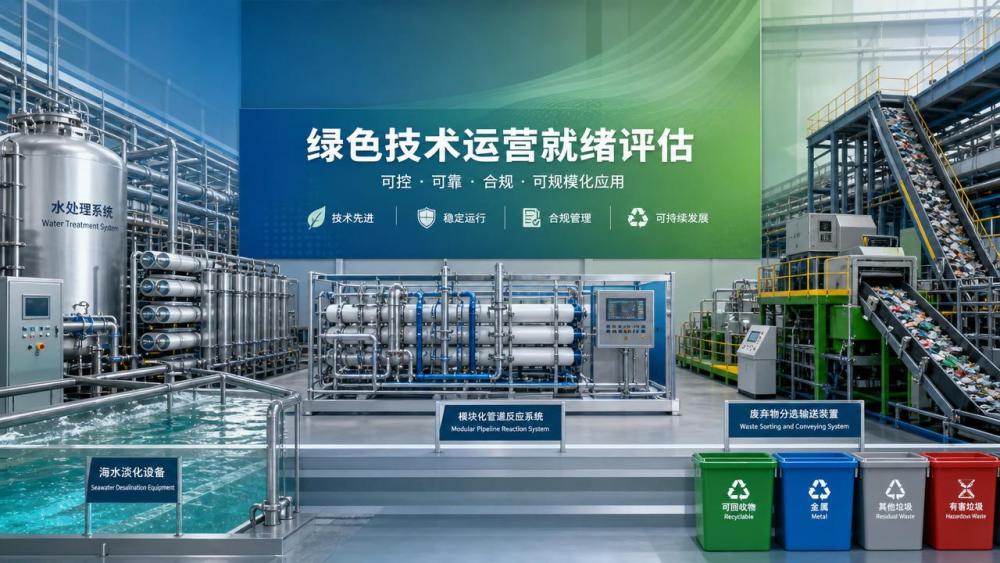
Operational readiness is the point at which a green tech solution can be introduced into a live industrial or municipal environment with predictable technical, regulatory, and economic behavior. In practice, this means more than passing a pilot. A pilot may prove a process can work for 8 weeks under supervised conditions; readiness means it can keep working for 8,000 hours per year with acceptable intervention rates and stable compliance output.
For sectors covered by ESD’s intelligence focus, the readiness threshold is usually higher than in light commercial technologies. A desalination skid, thermal recovery line, flue gas reactor, or hazardous waste stabilization system often operates within narrow design windows. A 10% deviation in salinity, calorific value, pH, chloride load, or particulate composition can materially affect membrane fouling, catalyst life, corrosion rate, or residue classification.
The five core dimensions evaluators should verify
- Performance consistency under feedstock or influent variation of at least 15% to 30%.
- Compliance reliability against discharge, emissions, or waste acceptance criteria.
- Maintainability, including service intervals, consumables access, and operator workload.
- Scale-up integrity from pilot, demo, or modular deployment to commercial throughput.
- Lifecycle economics covering energy, chemicals, labor, downtime, and residual handling.
Why the definition matters by application
In water treatment, a green tech solution may hit COD reduction targets in a controlled pilot yet fail when TDS spikes above the original design basis. In waste recovery, a sorting line can perform at 92% purity on well-segregated feed but drop below 80% when moisture or film contamination rises. In flue gas treatment, catalyst performance can shift sharply when temperature falls from 320°C to 220°C. Operational readiness must therefore be judged against the expected disturbance range, not only against nominal conditions.
A practical readiness lens
A useful rule is to ask whether the system can survive 4 tests at once: variable input, continuous operation, compliant output, and serviceability by the actual site team. If one of those four breaks, the green tech solution may still be innovative, but it is not yet fully operationally ready.
A step-by-step framework to assess readiness
Technical evaluators benefit from a structured review process rather than a simple vendor checklist. A 6-step framework helps compare technologies consistently across different environmental infrastructure projects. It also reduces the risk of overweighting a single metric such as recovery rate or energy intensity.
Step 1: Confirm the operational envelope
Start with the design basis. Define the expected influent or feed range, target throughput, ambient conditions, duty cycle, and utility availability. For example, if a treatment line is specified for 500 to 800 m³/day, pH 4 to 9, and TSS below 250 mg/L, do not accept pilot results generated at 200 m³/day under narrower conditions. A green tech solution is only ready for the site if its validated operating envelope overlaps the real plant envelope by a meaningful margin.
Step 2: Review evidence quality, not just claims
Ask what kind of evidence supports the performance statement. Bench tests, supervised pilots, third-party trials, and long-duration site operation do not carry equal weight. A 2-week pilot with handpicked feedstock may be useful, but it does not replace 6 to 12 months of logged runtime data with maintenance records, alarm history, and off-spec events.
The table below can be used to distinguish levels of evidence when reviewing a green tech proposal.
The key conclusion is simple: evidence maturity should match investment exposure. The larger the capex, compliance penalty, or outage consequence, the more the evaluator should rely on sustained commercial data rather than pilot narratives.
Step 3: Measure reliability and maintainability together
Many green tech reviews focus on efficiency but neglect maintenance reality. Ask how often filters, nozzles, membranes, seals, reagent systems, sensors, and catalyst modules need service. A process that achieves excellent removal rates but requires weekly manual cleaning, 48-hour specialist intervention, or imported spare parts with 10-week lead times may not be operationally ready for a remote or labor-constrained site.
Useful maintainability checks
- Can standard operators handle routine tasks after 2 to 5 days of training?
- Are critical consumables available within 2 to 4 weeks in the target region?
- Does the system require shutdowns more frequently than the host plant can tolerate?
- Can key components be replaced without lifting heavy upstream assemblies or opening hazardous zones?
Step 4: Test scale-up logic
Scale-up failure is common when residence time, mixing energy, thermal gradients, solids loading, or automation complexity changes nonlinearly with size. A green tech process proven at 5 m³/day or 1 ton/day should not be assumed to behave identically at 500 m³/day or 100 tons/day. Evaluators should ask for scale-up assumptions, modular replication logic, and bottleneck analysis for pumps, blowers, agitators, heat transfer surfaces, and residue handling.
Step 5: Verify compliance under upset conditions
Compliance readiness should be tested at start-up, shutdown, feed surges, and partial equipment failure. A flue gas system that meets design emissions at steady full load but fails during low-load cycling is not ready for flexible power or industrial duty. A waste treatment process that meets leachability limits in normal operation but lacks contingency handling for off-spec residues also remains high risk.
Step 6: Build a lifecycle cost view
Capex alone rarely reveals readiness. A technically elegant green tech solution may become unattractive if energy demand rises from 2.5 to 4.0 kWh/m³ during realistic fouling conditions, or if chemical consumption doubles under variable influent. Evaluators should model at least 5 cost lines: power, chemicals, labor, maintenance, and waste or brine disposal. A 10% gain in recovery may be less valuable than a 30% reduction in downtime.
Key indicators that a solution is ready for water, waste, desalination, and hazardous applications
Readiness indicators vary by subsector, but several patterns recur across environmental infrastructure. The evaluator’s task is to identify whether the technology can control its main failure modes while still delivering economic value. The table below summarizes typical indicators used in green tech screening for complex industrial applications.
These indicators show that operational readiness is application-specific but still governed by the same principle: the technology must demonstrate stable control of process variability, not just peak efficiency under ideal conditions.
Sector-specific red flags
In desalination, beware of solutions that quote low specific energy consumption without clarifying salinity, temperature, recovery ratio, and pretreatment burden. In waste pyrolysis, watch for insufficient evidence on feed uniformity, residue quality, and emissions control. In flue gas systems, confirm whether guaranteed performance applies across low-load and high-sulfur conditions. In hazardous waste management, documentation discipline is as important as core process chemistry.
Three questions that quickly expose immaturity
- What happens when the influent or feed composition moves outside the median by 20%?
- What are the top 3 causes of unplanned downtime, and how are they corrected?
- Which operating assumptions most affect lifecycle cost over 5 years?
Procurement, implementation, and post-installation checks
For technical evaluators involved in procurement, readiness must be translated into contract language, commissioning logic, and service expectations. A sound commercial package should define acceptance metrics, operating responsibilities, training scope, spare parts lists, and performance verification periods. Without these controls, even a strong green tech solution can become difficult to validate after delivery.
What to include in the technical review package
At minimum, request PFDs, utility requirements, maintenance schedules, consumable assumptions, control philosophy, upset response procedures, and a matrix showing guaranteed performance versus feed conditions. For medium to high-risk projects, a 30-day to 90-day post-commissioning verification window is often more meaningful than a single 72-hour test run.
The checklist below helps align procurement decisions with actual field readiness.
A well-built review package reduces ambiguity. It also enables technical teams, procurement leads, and compliance stakeholders to assess the same green tech solution through a common decision framework rather than isolated assumptions.
Common evaluation mistakes
- Accepting removal efficiency or recovery as the main decision metric.
- Ignoring residue, brine, ash, or secondary waste logistics.
- Assuming pilot success proves commercial uptime.
- Underestimating operator skill and maintenance discipline requirements.
- Overlooking regulatory changes that can tighten discharge or traceability rules within 12 to 24 months.
How intelligence-led evaluation adds value
In high-value environmental projects, readiness assessment improves when it combines equipment data with market and regulatory intelligence. That is particularly relevant in sectors shaped by CBAM pressure, carbon accounting, stricter water reuse rules, and waste traceability obligations. A green tech solution that appears acceptable today may become less attractive if its energy intensity, chemical dependency, or documentation burden creates future compliance or bidding disadvantages.
For technical evaluators, the strongest decision process links process engineering, field operability, and strategic context. This is where specialist intelligence platforms such as ESD help organizations test not only whether a system works, but whether it remains competitive, compliant, and serviceable as project conditions evolve.
A green tech solution is operationally ready when it can deliver repeatable results across real feed variation, meet compliance targets during routine and upset conditions, fit the maintenance capabilities of the site, and hold its economics over years rather than weeks. That standard is essential in water treatment, waste recovery, desalination, flue gas control, and hazardous waste applications where technical underperformance quickly becomes a financial or regulatory problem.
If you are screening technologies for a live project, ESD can support your decision process with deeper sector intelligence, application-focused evaluation logic, and practical procurement insight. Contact us to discuss your operating scenario, get a tailored assessment framework, or explore more solutions for complex environmental infrastructure.
Recommended News
How feed salinity affects energy use in ZLD system brine treatment
ZLD system brine treatment: discover how feed salinity drives energy use, scaling risk, and technology choices for efficient, reliable zero liquid discharge.
How coastal cities can select desalination solutions for peak demand
Seawater desalination solutions for coastal cities: compare firm peak capacity, intake risk, energy resilience, and lifecycle value to secure reliable water supply.
How SCR denitrification systems in Europe meet Industrial Emissions rules
SCR denitrification systems Europe: learn how permit-led design, ammonia-slip control, catalyst management and monitoring support Industrial Emissions compliance.
When does MBR equipment make sense for wastewater reuse?
Water treatment equipment for wastewater reuse: learn when MBR delivers compact, reliable low-solids effluent—and when alternative treatment trains offer better value.
How North America shapes global environmental governance standards
Global environmental governance North America: discover how regulation, finance, and procurement raise worldwide standards and reshape environmental projects.
How reactor capacity affects throughput in pyrolysis systems
Pyrolysis systems reactor capacity explained: learn how heat transfer, residence time, feed quality, and emissions controls determine reliable throughput.
When low-temperature reaction equipment is the right fit for heat-sensitive processes
Low-temperature reaction equipment helps protect heat-sensitive streams, improve energy integration, and maintain reliable conversion. Explore key selection factors today.
When do water reuse systems deliver a practical payback?
Water reuse systems deliver practical payback when they cut water, discharge, and downtime costs. Learn how to match treatment, recovery, and reuse quality for lasting ROI.
When do ZLD systems for power generation justify their energy use?
ZLD systems for power generation: learn when energy-intensive water recovery delivers stronger compliance, resilience, and long-term value.