
Industry News
Curation by industry experts
Hot Articles
Popular Tags
How to Evaluate AI Waste Sorting Software for Accuracy and ROI
Accuracy is not a demo score
Choosing AI waste sorting software used to be framed as a vision-system upgrade. It is not that simple anymore. In modern material recovery and waste-to-resource operations, the software layer affects bale quality, downstream contamination, line stability, labor allocation, maintenance planning, and in some facilities even permit risk. A platform that performs well in a controlled vendor test can still disappoint when the feed shifts from relatively clean packaging waste to wet municipal streams, black plastics, multilayer films, or construction debris with high visual noise.
That is why technical evaluation has to start with a slightly uncomfortable question: accurate at what, under which stream conditions, and measured how? If the answer stays vague, the ROI discussion will be vague too.
Across the broader environmental equipment landscape, this is a familiar pattern. Whether evaluating SWRO membrane performance, SCR catalyst behavior at low temperatures, or AI waste sorting software on mixed lines, the core problem is the same: extreme operating conditions expose the gap between brochure claims and field reality. For intelligence platforms such as ESD that track resource recovery systems alongside water treatment, flue gas control, desalination, and nuclear waste management, that cross-sector view matters. The best evaluation methods are rarely the ones with the best slides; they are the ones that survive dirty inputs, regulatory pressure, and long operating hours.
Define the sorting objective before comparing vendors
Many teams compare software before they have agreed on what the line is actually trying to optimize. That sounds basic, but it is a common source of bad procurement decisions.
One facility may care most about recovering PET from a relatively stable packaging stream. Another may be under pressure to reduce contaminants in RDF production. A third may need to identify batteries, e-waste fragments, or hazardous items early enough to protect equipment and fire safety. These are not the same technical problem, even if every vendor describes the solution as “AI-powered sorting.”
Before evaluating any platform, pin down four items: target fractions, purity threshold, recovery target, and operating window. If your line handles seasonal variation, high moisture, bagged waste, or dark materials, write that into the evaluation scope. Otherwise the software may be optimized for a feed that looks nothing like yours.
What accuracy really means on a sorting line
Vendors often use “accuracy” as a headline metric, but in practice you need a more granular view. For sorting applications, the useful questions are usually these:
- Detection accuracy: can the system identify the target item correctly?
- Classification consistency: does it still perform when materials are crushed, soiled, overlapping, or partially obscured?
- Pick accuracy: does the command translate into a successful air-jet or robotic separation event?
- False positive rate: how often does the system reject valuable non-target material?
- Drift over time: does performance fall as the stream changes or as lighting, dust, and equipment conditions shift?
A model can look excellent on labeled images and still underperform on the conveyor. Real lines introduce belt speed variation, motion blur, object overlap, inconsistent size distribution, and contamination that optical systems do not enjoy. This is why software should be evaluated together with the sensing stack and actuation layer, not as an isolated algorithm.
Ask how the model was trained, but do not stop there
Training data quality matters, but not in the superficial way it is often presented. A large dataset is helpful only if it resembles the material stream you will run. Ask whether the model has been trained on post-consumer waste, commercial waste, industrial scrap, C&D waste, or mixed municipal inputs. Ask whether black plastics, wet fiber, deformable films, labels, and food residue were part of the training environment.
Then ask a harder question: how is the model updated after installation? Waste composition is not static. Packaging formats change. Local collection systems change. Regulatory pressure can push facilities toward higher purity thresholds. A platform that cannot be retrained or fine-tuned without major downtime may look economical on day one and expensive by year two.
Technical teams should also clarify the human workflow behind model maintenance. Who validates edge cases? How are mislabeled picks reviewed? Is there a feedback loop from line operators to the software team? In practice, operational learning often matters more than the initial demo.
Test under your own material conditions
The most credible evaluation method is still a trial using representative feedstock. If a full on-site pilot is not feasible, at least insist on tests using samples that reflect your contamination profile, moisture range, particle size, and throughput conditions.
A useful trial plan usually includes normal operating material, not just hand-prepared samples. It should also include difficult periods: after rain, during seasonal surges, after upstream screening changes, or whenever the line typically struggles. A system that performs beautifully only on “good days” is not solving the right problem.
If the vendor reports a single top-line recovery number, ask for the confusion matrix or at least a breakdown by material class. Knowing that the model confuses PET trays with PET bottles, or HDPE containers with PP packaging, may be far more relevant than a polished average score.
Throughput, latency, and line integration often decide the outcome
In selection meetings, software evaluation tends to focus on recognition quality. On running plants, latency and integration issues are often what create the headaches.
The software has to make decisions fast enough for your belt speed and object density. That means technical reviewers should look at end-to-end timing: image capture, inference, command transmission, and actuation response. Even small delays can reduce pick reliability when items are irregularly spaced or when the line is running at high throughput.
Integration questions are just as practical. Does the platform work cleanly with existing NIR, RGB, hyperspectral, robotic, or air-ejection hardware? Can it exchange usable data with SCADA, MES, or plant reporting systems? Does it create operator dashboards that are actually interpretable during a shift, or just engineering dashboards that look good in presentations?
A strong AI engine with weak plant integration can become a maintenance burden. Technical evaluators should involve controls engineers and line supervisors early, not after vendor shortlisting.
ROI is broader than labor savings
The ROI conversation gets distorted when it is reduced to headcount reduction. Labor matters, of course, especially where sorting jobs are difficult to fill or turnover is high. But in many projects, the more durable value comes from material quality and process stability.
A sensible ROI model for AI waste sorting software should consider at least the following:
Not every project will monetize each item cleanly. Commodity prices fluctuate, offtake contracts vary, and local reporting obligations differ. Still, a broader ROI frame gives a much more realistic picture than “software cost versus sorter wages.”
Do not ignore compliance and traceability
In resource recovery, compliance is moving closer to operations. Facilities increasingly need better documentation around recovered fractions, reject rates, contamination management, and in some markets the carbon and circularity logic behind material flows. That is one reason intelligence-led operators and EPC firms now look beyond mechanical separation alone.
Software that produces auditable sorting records, trend reports, and exception logs can become useful well beyond the line itself. It can support internal quality control, buyer negotiations, and project documentation. For groups following policy shifts such as CBAM-related pressure on industrial supply chains, traceability is not a side feature. It is becoming part of investment logic.
Common evaluation mistakes
One mistake is buying for maximum technical sophistication instead of operational fit. Not every facility needs the most advanced model stack if feed composition is relatively stable and maintenance resources are thin.
Another is separating software procurement from mechanical line reality. If upstream screening is unstable, conveyor presentation is poor, or housekeeping is weak, software will be blamed for problems it did not create.
A third is trusting pilot results without defining acceptance criteria in advance. Decide early what counts as success: purity threshold, recovery uplift, false reject limit, response time, uptime expectation, and support SLA. Without that discipline, the post-trial discussion becomes subjective very quickly.
A practical shortlist framework
When narrowing options, it helps to score vendors across five dimensions: fit to target waste stream, field performance transparency, integration effort, maintainability, and economic realism. That last point matters. If the business case only works under perfect commodity prices and ideal contamination assumptions, it is fragile.
The better platforms usually show a certain maturity in how they discuss limitations. If a vendor can explain where the model struggles, what data would improve it, and how performance should be monitored after commissioning, that is often a better sign than a flawless marketing narrative.
In the end, evaluating AI waste sorting software is less about chasing a headline accuracy number and more about understanding behavior under stress. Technical evaluators should look for evidence that the system can hold performance across messy, changing, high-throughput conditions while supporting a credible economics case. If the software can do that, it is not just a digital add-on to the line. It becomes part of the decision architecture of modern resource recovery.
Recommended News
When do water reuse systems deliver a practical payback?
Water reuse systems deliver practical payback when they cut water, discharge, and downtime costs. Learn how to match treatment, recovery, and reuse quality for lasting ROI.
When do ZLD systems for power generation justify their energy use?
ZLD systems for power generation: learn when energy-intensive water recovery delivers stronger compliance, resilience, and long-term value.
Which decarbonization pathways are most viable in Southeast Asia?
Decarbonization Southeast Asia: discover practical pathways for clean power, efficiency, electrification, circular recovery, and resilient industrial growth.
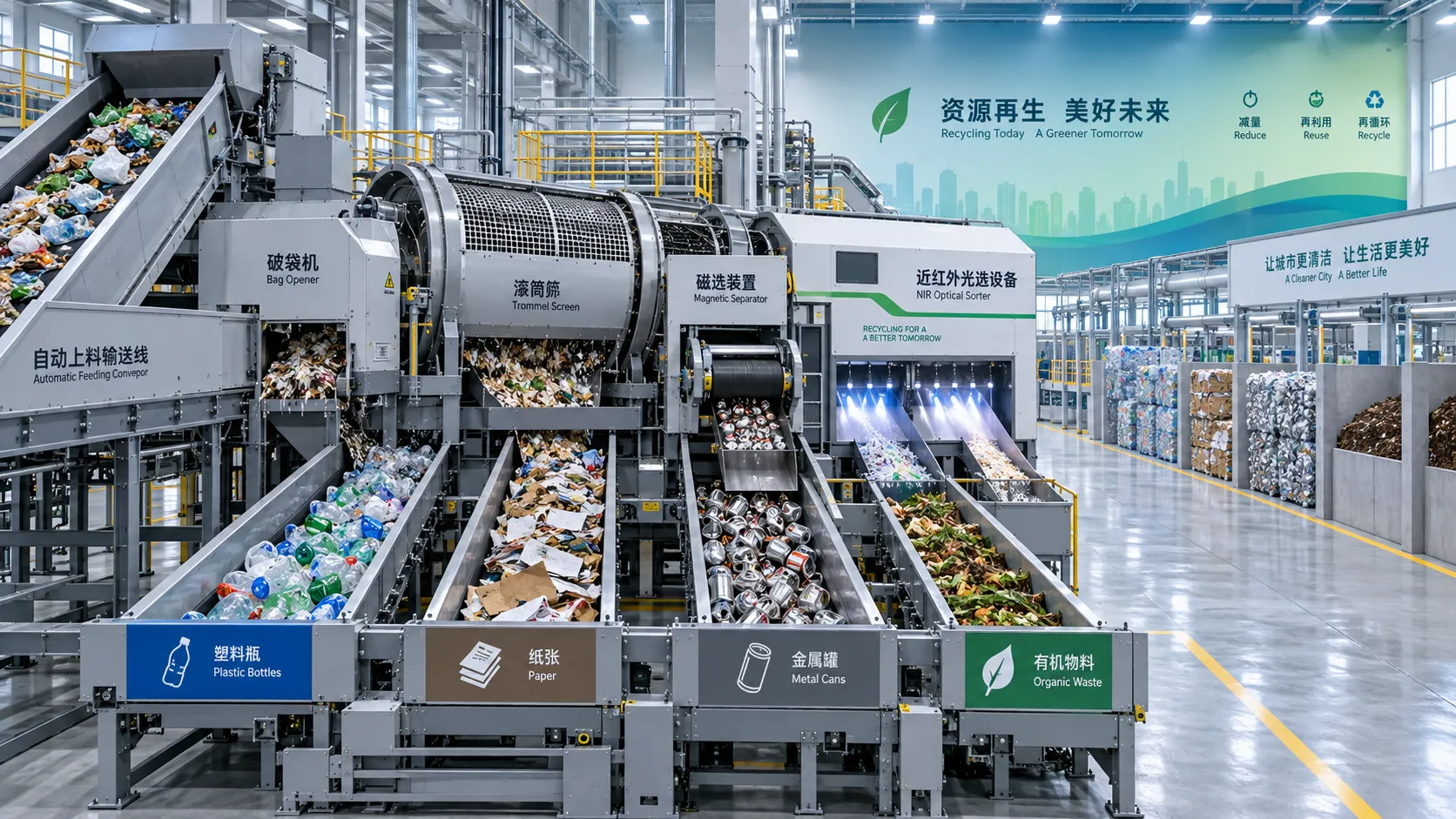
How to choose waste sorting equipment for mixed municipal waste
Waste sorting equipment selection guide for mixed municipal waste: compare technologies, improve recovery, reduce downtime, and build reliable output streams.
How to verify standards in an environmental equipment directory
environmental equipment directory standards reference: learn to verify certifications, performance evidence, scope, and project fit for confident, compliant equipment selection.
When high flux membrane water treatment justifies a larger footprint
High flux membrane water treatment can justify a larger footprint when variable feedwater, fouling risk, and uptime demands require resilient, lower-flux operation.
RO vs MED desalination: which is more energy-efficient at scale?
Desalination technology comparison: RO vs MED at scale. See how energy use, waste heat, feedwater, carbon, and flexibility determine the best choice.
Which ISO standards apply to flue gas treatment systems?
Flue gas treatment systems ISO standards: explore key requirements for emissions testing, CEMS, safety, fabrication, corrosion control, and compliant project evaluation.

When corrosion resistant purification systems are needed for brine treatment
Corrosion resistant purification systems for brine treatment: assess chloride, heat, scaling, materials, and lifecycle reliability for demanding water projects.